
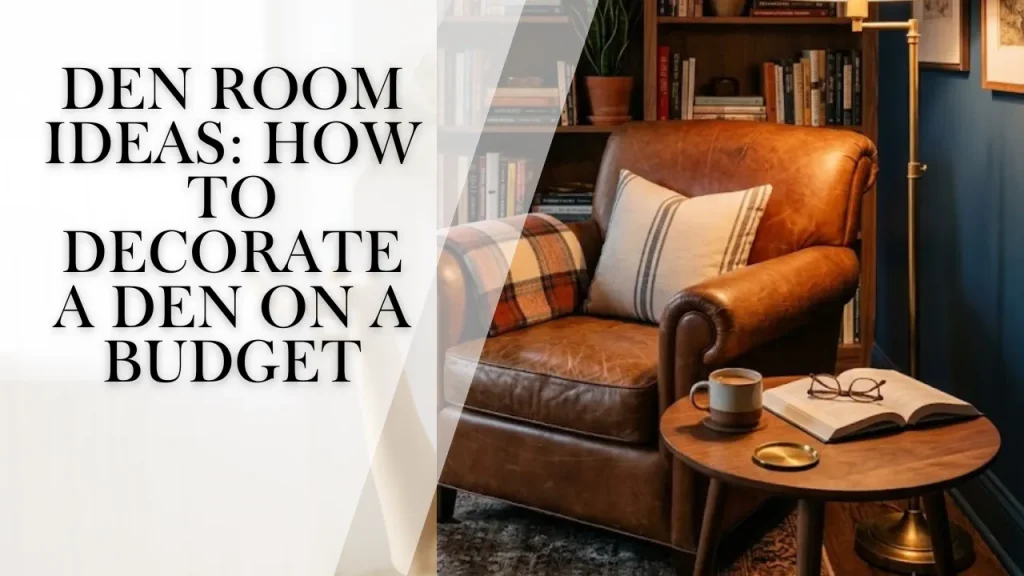
The den is the room that confuses people most. It is not quite a living room, not quite an office, and not quite a guest room, and in a lot of homes, it ends up as none of those things, just a space where furniture goes to wait indefinitely for a purpose. If you have a den and you are not sure what to do with it, you are in good company.
A den is technically defined as a small, informal room in a house, usually separate from the main living areas, often used for relaxing, reading, or working. In practice, what counts as a den varies a lot depending on the home, it might be a converted spare bedroom, a bonus room off the hallway, a finished basement space, or a recessed alcove that does not quite qualify as its own room. What they have in common is that they tend to be smaller and more enclosed than a living room, which is actually an advantage when it comes to decorating: smaller spaces are easier and cheaper to transform.
Here is how to approach den room decorating ideas without overspending or overcomplicating them.
Decide What the Den Is Actually For
Before buying a single piece of furniture, settle on the primary function of the space. A den can work as a home office, a reading room, a TV room, a hobby space, a quiet retreat, or a guest overflow room, but trying to make it all of those things at once usually means it does not do any of them well.
Pick one primary use and one secondary use at most. A reading nook that doubles as a guest room when needed is manageable. A room trying to serve as an office, a gym, a movie room, and a craft space at the same time tends to feel chaotic regardless of how much money you spend on it.
Once the function is clear, the furniture and decor choices become much simpler.
Lean Into the Enclosed Feel

One of the most common mistakes in den decorating is trying to make the space feel like a bigger, brighter version of the living room. That works against what a den naturally does well. The enclosed, lower-light quality of most dens is not a flaw to fi,it is a feature to lean into.
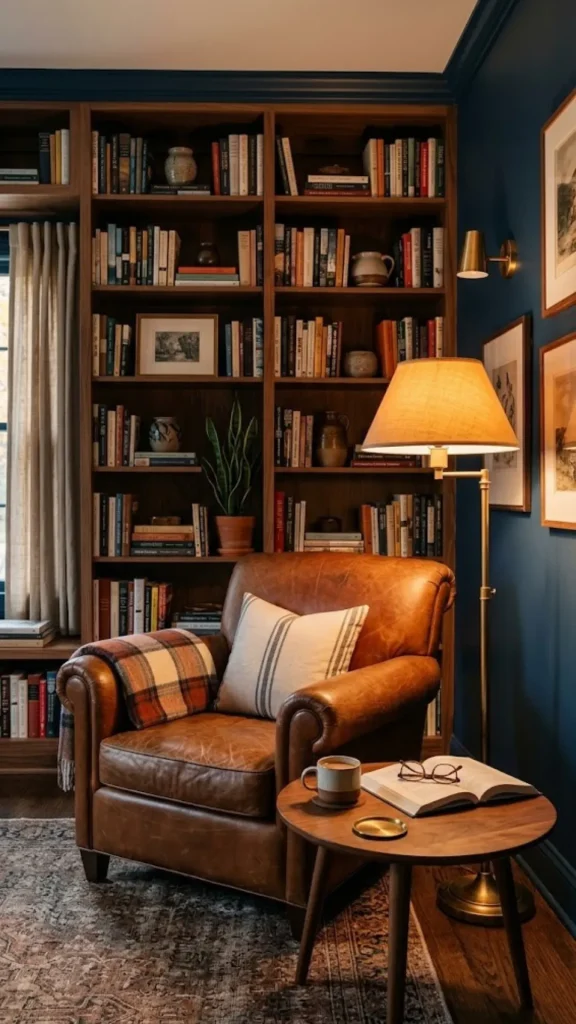
Darker, moodier paint colors work better in a den than they do in a main living space. Deep navy, forest green, charcoal, terracotta, or a warm burgundy all read as intentional and rich in a small, enclosed room rather than heavy and claustrophobic. A color that would feel oppressive in a large open-plan living room often feels cozy and deliberate in a den.
If painting is not an option, common for renters, a large dark-toned rug and deep-colored textiles achieve a similar effect without touching the walls.
Choose Furniture That Fits the Scale
Den rooms are smaller than living rooms, which means standard living-room-sized furniture almost always looks wrong. A full three-seater sofa in a small den leaves no room for anything else and makes the space feel cluttered before it is even decorated.
Scale down intentionally. A loveseat or a pair of armchairs serves the same seating function in a den without overwhelming the footprint. A smaller coffee table or a single ottoman does the job of a full coffee table setup. Built-in shelving or narrow floating shelves use vertical space without eating into floor area.
Thrift stores and secondhand markets are particularly useful here because den-sized furniture, smaller sofas, compact armchairs, and narrow side tables, tends to be overlooked by buyers shopping for main living spaces and is often priced lower as a result.
Add a Built-In Feel Without Building Anything
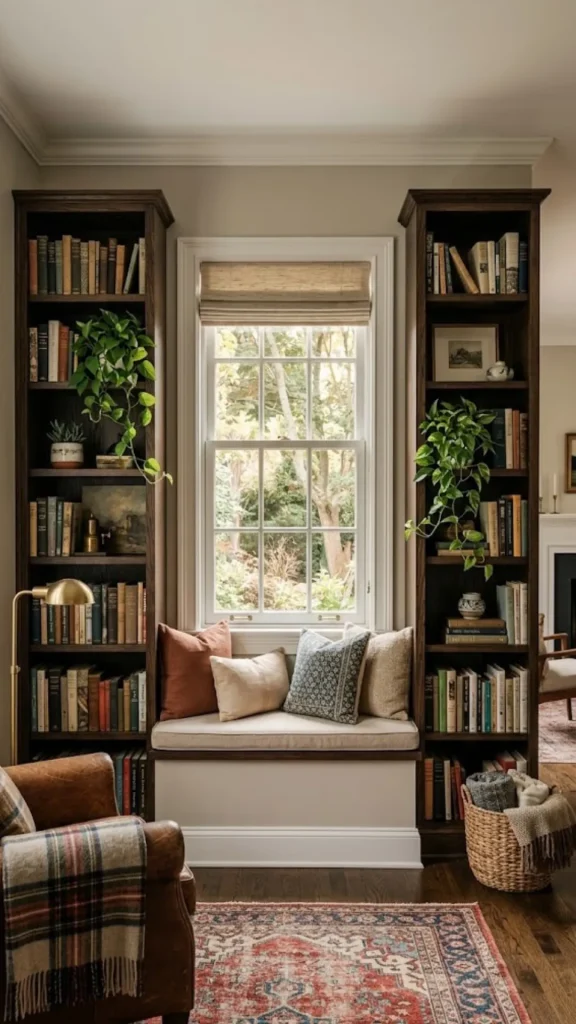
One of the most effective den room decorating ideas that costs very little is creating the illusion of built-in shelving using freestanding units. A pair of matching bookcases flanking a window or a TV unit creates a symmetrical, built-in look without any renovation. Painting the bookcases the same color as the wall behind them reinforces the effect further.
This approach works especially well in rented spaces because it is entirely temporary, the bookcases move out with you, but it looks far more intentional than a single freestanding unit placed against a wall.
Use Lighting to Set the Tone

Den rooms often have less natural light than main living areas, and the instinct is usually to compensate with bright overhead lighting. This tends to work against the cozy, retreat quality that makes a den worth having.
Instead, layer lighting at different heights: a floor lamp in one corner, a table lamp on a side table, and potentially a small wall sconce or picture light if the space allows. Warm-toned bulbs (2700K–3000K range) reinforce the enclosed, relaxed atmosphere. A dimmer switch on any overhead light is a low-cost addition that gives significant control over the room’s mood.
Treat the Den Like a Personality Room
The main living room in most homes has to work for everyone; it is shared, multi-purpose, and usually kept fairly neutral to accommodate different needs and tastes. The den does not have that constraint. It is typically a secondary space used by one person or one type of activity, which means it can carry more personality than the rest of the house without feeling out of place.
This is the room for the gallery wall you were not sure about in the living room, the bold rug pattern that felt too risky elsewhere, the stacks of books on every surface, the vintage record player, or the collection of objects that does not fit the main room’s aesthetic. A den that reflects a specific interest or aesthetic strongly tends to feel more successful than one that tries to be generically tasteful.
Den vs Living Room—Know the Difference When Shopping
One practical note on sourcing den furniture: because dens are less well-known as a room category than living rooms or bedrooms, searching specifically for “den furniture” or “den room ideas” on secondhand marketplaces sometimes surfaces items that are priced as overlooked pieces rather than living-room staples. A compact Chesterfield loveseat, a leather club chair, a low mid-century credenza,these items fit a den well and tend to appear in secondhand listings without the premium that the same items carry when marketed for a living room.
A well-decorated den does not need a large budget or a major renovation. It needs a clear purpose, furniture scaled to the room, lighting that earns the cozy reputation dens are supposed to have, and permission to be a little more particular and personal than the rest of the house. Start with those four things, and the rest of the decisions become much easier.
If your front door opens straight into your living room, you aren’t stuck. Learn how to define your entrance with No Entryway? Ideas That Fake One on a Budget.