
If you’ve ever stood in a bedroom and thought, “This feels too small” or looked at floor plans trying to figure out if a room is actually livable, then you’re not alone. Bedroom size is one of those things that matters a lot more than people think when they’re choosing a home.
But what actually counts as a good size bedroom? The answer is more nuanced than a single number. Here’s the honest breakdown.

The Numbers First — Standard Bedroom Sizes
These are the generally accepted size ranges for bedrooms in the US:
| Bedroom Type | Size Range | Square Feet |
|---|---|---|
| Small bedroom | 8 x 10 ft | 80 sq ft |
| Average bedroom | 10 x 12 ft | 120 sq ft |
| Good size bedroom | 11 x 14 ft | 154 sq ft |
| Large bedroom | 12 x 16 ft | 192 sq ft |
| Master bedroom | 14 x 16 ft and above | 224+ sq ft |
Most building codes in the US require a minimum of 70 square feet for a room to legally be called a bedroom, with at least one dimension of 7 feet or more. That’s genuinely small, barely enough for a bed and a dresser.
What Is Considered A Good Size Bedroom?
The honest answer is that 110 to 150 square feet is where most people feel comfortable in a bedroom. That’s roughly a 10×11 or 11×14 foot room.
At that size you can fit:
- A queen bed comfortably
- Two bedside tables
- A dresser
- A small wardrobe or decent closet
- Enough floor space to actually walk around
Below 100 square feet starts to feel cramped for most adults unless the layout and storage are handled really well. Above 200 square feet starts to feel genuinely spacious.
What Makes a Bedroom Feel Good Beyond Square Footage
Here’s something that surprises most people, square footage tells only part of the story. Two rooms with identical dimensions can feel completely different depending on:
Ceiling height: A room with 9-foot ceilings feels significantly larger than the same room with 7-foot ceilings. High ceilings add perceived space that square footage alone doesn’t capture.
Window size and placement: Natural light makes a room feel larger. A smaller room with a large window often feels more spacious than a bigger room with a small one.
Layout efficiency: A 120-square-foot room with a badly positioned door and awkward corners can feel smaller than a well-laid-out 100-square-foot room.
Storage: A room where everything has a proper place feels larger than the same room drowning in visible clutter. Built-in storage or smart furniture choices can make a smaller room feel much more generous.
Color and lighting: Light walls and warm layered lighting make a room feel open and airy. Dark walls and a single overhead light can make even a large room feel small.

Good Bedroom Size by Bed Type
If you’re trying to figure out whether a room is big enough for the bed you want, here’s a practical guide:
| Bed Size | Minimum Room Size | Comfortable Room Size |
|---|---|---|
| Twin (38×75″) | 8×10 ft | 10×10 ft |
| Full/Double (54×75″) | 9×10 ft | 10×12 ft |
| Queen (60×80″) | 10×10 ft | 11×12 ft |
| King (76×80″) | 10×12 ft | 13×13 ft |
These minimums allow the bed to fit, but “minimum” means you’ll be squeezing past the foot of the bed and probably can’t open dresser drawers fully. The comfortable sizes give you space to actually live in the room.
What About Master Bedrooms?
A good-sized master bedroom is generally considered to be at least 200 square feet, roughly 14×14 or 12×16 feet. That’s enough for a king bed, two nightstands, a dresser, a seating area, and access to an ensuite if there is one.
In practice, many master bedrooms in apartments and smaller homes fall below this. A 12×12 master bedroom (144 sq ft) is perfectly livable with a queen bed and thoughtful layout.
How To Make Any Bedroom Size Work
Whether your room is 80 square feet or 180, these are the principles that make the most difference:
Get the bed right first. The bed sets the scale for everything else. Choose the largest bed that fits comfortably, not the largest bed that physically fits, and position it to leave walkways on at least two sides.
Use vertical space. Floating shelves, tall wardrobes, and wall-mounted nightstands, moving storage off the floor and onto walls is the single biggest practical change in a small bedroom.
Control the clutter. A bedroom with visible clutter feels half the size of a tidy one. Every item needs a home. If it doesn’t have one, it lives on surfaces and makes the room feel chaotic.
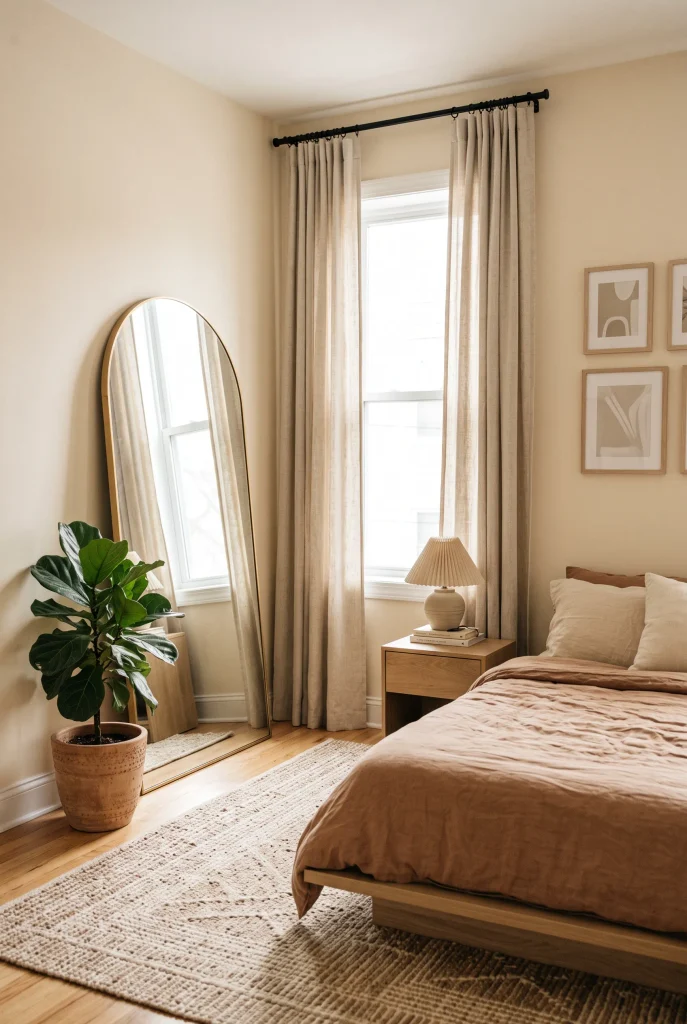
Mirror and light. A large mirror on the wall opposite a window effectively doubles the perceived size of the room. Warm layered lighting lamps rather than just overhead makes the room feel more spacious and inviting.
Keep the floor clear. As much floor as possible should be visible. The floor is what your eye uses to judge the size of a room. More visible floor = bigger feeling room.
Is Your Bedroom Too Small? Here’s What To Do
If your bedroom is on the smaller side under 120 square feet, don’t panic. There’s a lot you can do to make it feel significantly better without changing the dimensions.
The most impactful changes, in order:
- Declutter and clear surfaces completely
- Add a large mirror
- Swap to warm light bulbs and add a bedside lamp
- Mount floating shelves to move storage off the floor
- Use under-bed storage for anything you don’t need daily
- Add light curtains hung high and wide to make the window feel larger
- Choose one accent wall rather than busy decor on all four
A well-organized, well-lit, thoughtfully styled 100-square-foot bedroom can feel more comfortable and inviting than a poorly considered 160-square-foot one. Size matters but it’s not the whole story.
Final Thoughts
A good-sized bedroom is one that fits your bed, your storage needs, and your daily routine without feeling cramped. For most people that’s somewhere between 110 and 150 square feet, but what makes a bedroom feel good is as much about how it’s set up as how big it actually is.
If you’re working with a small bedroom right now, the articles below will help you make the most of every square foot.
Ready to transform your bedroom no matter the size? Check out these guides:
- 15 Small Bedroom Ideas That Make Tiny Rooms Look Huge
- Small Bedroom Storage Ideas That Actually Work
- Very Small Bedroom Ideas That Maximize Every Inch