

There’s a specific kind of tired that comes from a squeaky bed. You finally get comfortable, you shift an inch to find that sweet spot, and creeeak. Your partner sighs. The dog lifts its head. You’re wide awake again, staring at the ceiling, wondering why a piece of furniture you paid good money for sounds like a haunted ship.
I’ve torn apart more bed frames than I’d like to admit while furnishing rental flips and helping friends troubleshoot their bedrooms, and here’s the good news: a squeaky bed is almost never a “replace it” problem. It’s a “tighten this, pad that, lubricate the other thing” problem. Most fixes below take less than 20 minutes and use tools you probably already own.
Here’s how to actually find ,and fix ,the source of the noise.
Step 1: Figure Out Where the Squeak Is Coming From
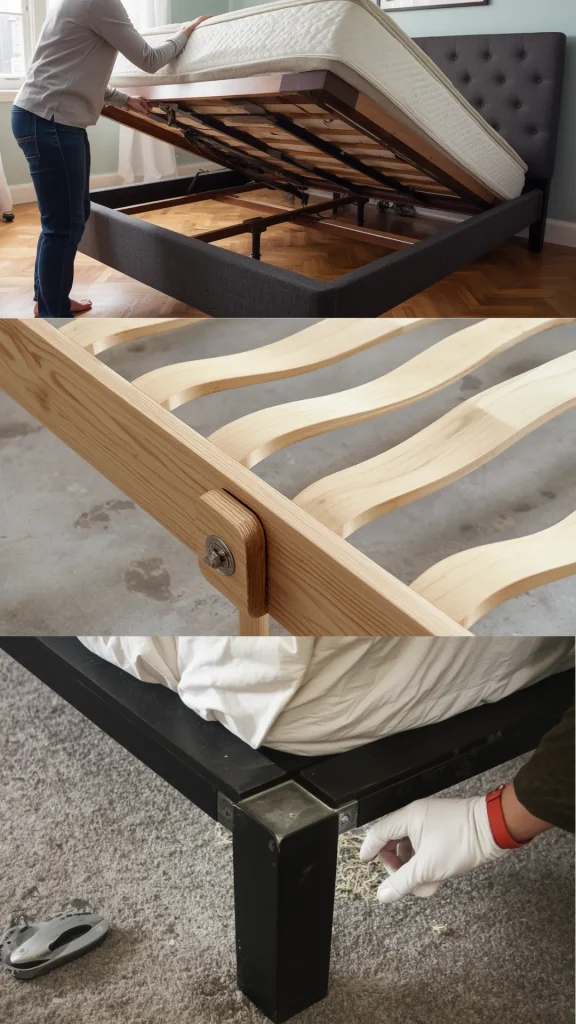
Before you reach for a wrench, take five minutes to isolate the sound. Squeaks generally come from one of three places, and treating the wrong one wastes time.
- Strip the bed and lift the mattress off the frame. Press down on it directly on the floor. If it still squeaks, the noise is coming from worn-out springs inside the mattress or box spring ,not the frame.
- If the mattress is silent on the floor, put it back and have someone roll around on the empty frame (or do it yourself, carefully). Listen closely near the joints, the center support, and where the slats meet the rails.
- Check the legs last. Have someone gently rock the frame side to side while you watch where it makes contact with the floor.
Once you know the source, the fix is usually obvious.
2. Tighten Every Bolt and Screw
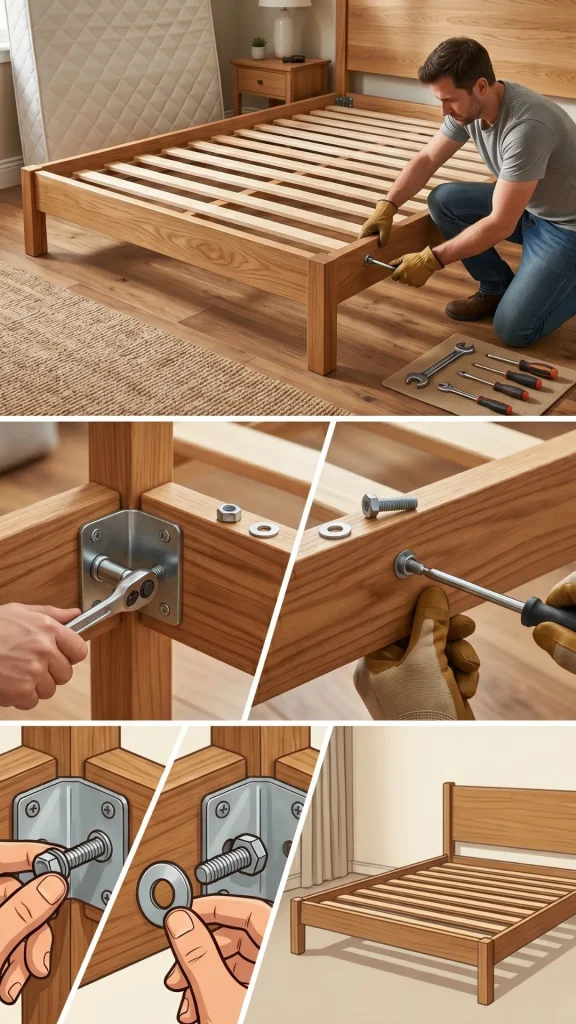
This is the single most common cause of a squeaky bed, and it’s the first thing to check. Wood and metal bed frames rely on tension between bolts, screws, and connector plates. Over months of use, normal movement loosens those connections just enough to create friction ,and friction makes noise.
Pull the mattress off and go around the entire frame: headboard brackets, footboard brackets, side rails, and the center support beam. Use a wrench or screwdriver to snug everything back up. Don’t overtighten wood screws, though ,stripping the hole makes things worse, not better.
If a bolt spins without tightening, the threads are likely worn. Swap it for a slightly larger bolt or add a washer to create more grip.
3. Lubricate Metal-on-Metal Contact Points
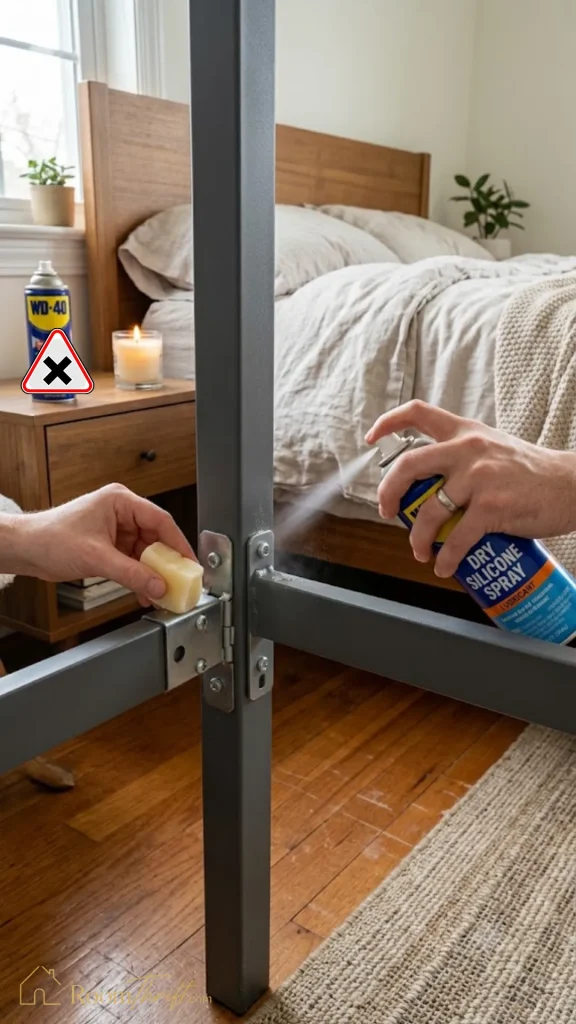
If your frame is metal or has metal brackets and bed frame parts, squeaking is often just two metal surfaces rubbing without anything between them. A dry silicone spray or a bit of paraffin wax (an old candle works fine) on hinges, brackets, and the points where the frame connects is usually enough to quiet things down. Avoid WD-40 as a long-term fix , it attracts dust and grime that can make the squeak return faster.
4. Pad Wood-on-Wood Contact Points
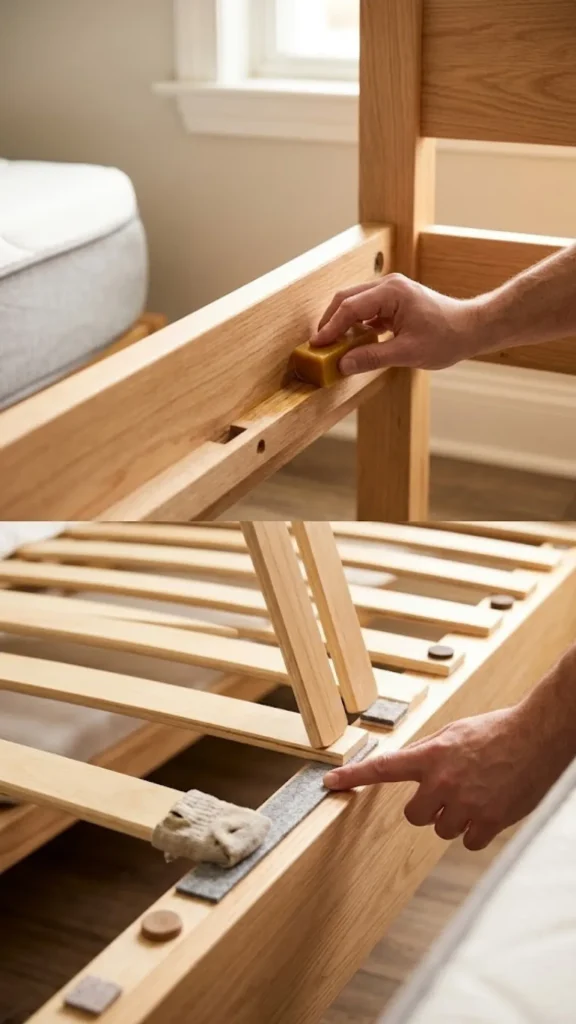
Wooden frames squeak for a different reason: wood naturally expands and contracts with humidity and temperature, and over time the joints shift just enough to rub. A thin layer of beeswax, paraffin, or even a bar of soap rubbed into the joint where wood meets wood reduces friction without affecting the structure. For slats that rub against the rail, a strip of felt, an old sock, or a rubber furniture pad glued to the contact point works well and is invisible once the mattress is back on.
5. Add Support Under the Mattress

A lot of squeaks cluster in the middle of the bed simply because that’s where the most weight and flex happen. If your frame doesn’t already have a center support bar, adding one — or adding extra slats — spreads the load and stops the flexing that causes noise. A bunkie board or a sheet of half-inch plywood laid under the mattress can do the same job in a pinch and adds noticeable stability to platform beds especially.
6. Stabilize the Legs

If your rocking test pointed to the legs, the fix is simple: place felt pads or rubber furniture cups under each leg. This does two things , it stops the leg from sliding on hard flooring, and it absorbs small vibrations before they turn into a creak. If your floor is uneven (very common in older homes), slide a thin shim of cardboard or wood under the shorter leg to level the frame. An unlevel frame rocks with every movement, and that rocking is often the real source of a “mystery” squeak that seems to come from nowhere.
7. Check the Box Spring Separately
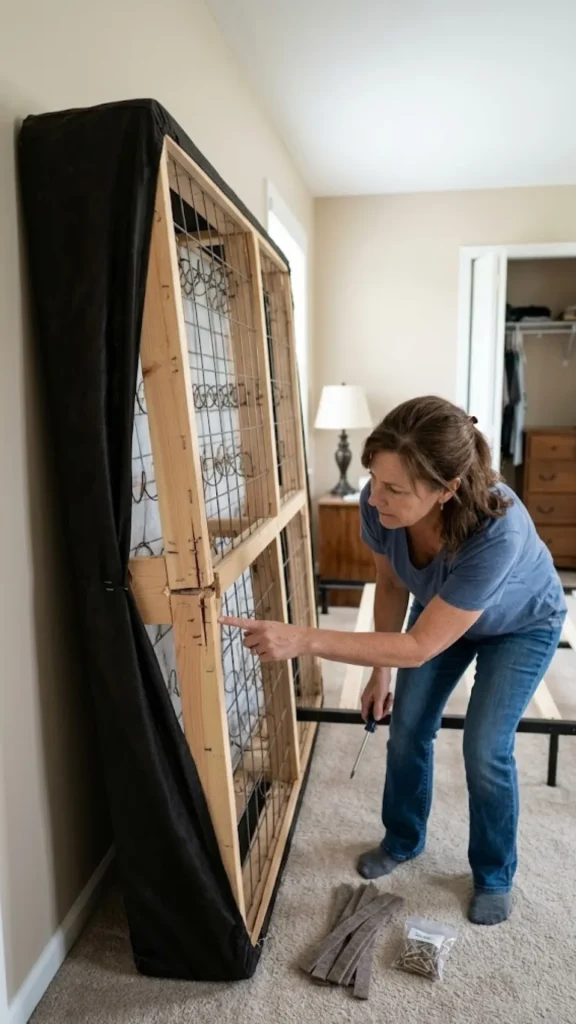
Box springs have their own internal frame and, often, their own set of squeaky little coil-and-wood connections. If isolating the mattress on the floor didn’t fix it but the box spring is still in play, flip it over and look for loose staples, separated wood joints, or a torn fabric lining rubbing against the frame. A few well-placed screws or a strip of felt at the contact points usually solves it.
8. Rotate or Replace a Noisy Mattress

If the squeak followed the mattress when you tested it alone on the floor, the issue is almost certainly aging innerspring coils. Rotating the mattress 180 degrees shifts your body weight onto less-worn coils and can buy you real quiet time, especially in mattresses under five years old. A mattress topper can muffle the sound further, though it won’t repair damaged coils. If the mattress is older and the squeak keeps returning no matter what you try, it’s a sign the coils themselves are worn out , at that point, no amount of WD-40 will out-stubborn physics.
9. Know When It’s a Structural Repair, Not a Maintenance Fix

Occasionally, a persistent squeak that survives tightening, lubricating, and padding points to actual damage: a cracked wooden rail, a warped metal bracket, or a broken center leg. Run your hand along wooden joints feeling for splits, and check metal brackets for visible bends. A cracked rail can usually be glued, clamped, and left to cure overnight. A bent metal joint may need a cheap weld or a hardware-store replacement bracket. These are rarer causes, but worth ruling out if the easy fixes don’t hold.
A Quieter Bed, Starting Tonight
Most squeaky bed problems come down to the same handful of culprits , loose hardware, dry friction points, an unlevel frame, or aging springs , and almost all of them are fixable in an afternoon with tools you already have in a junk drawer. Work through the steps above in order, starting with the simplest (tightening bolts) before moving to anything that involves taking the frame apart.
A few minutes of maintenance now mean a lot more uninterrupted sleep later ,for you, your partner, and anyone else in the house who’s been silently judging your bed for months.
For more bedroom inspiration, read our full guide on Rustic Bedroom Ideas on a Budget That Feel Expensive